
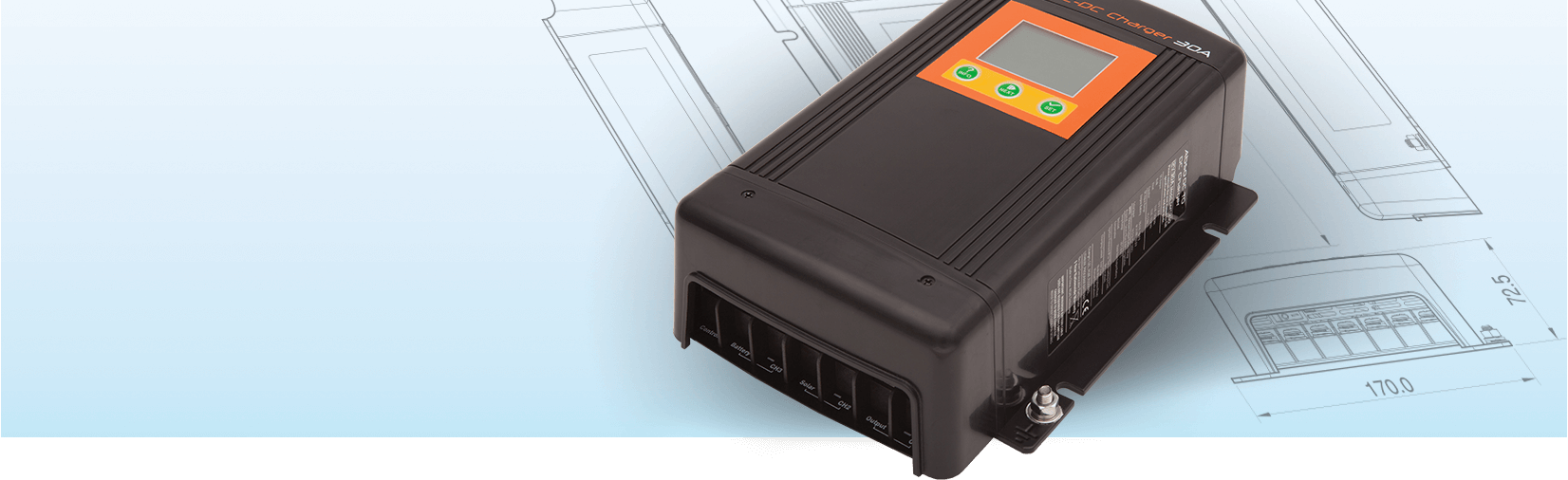
DC-DC Battery Chargers
Charge your house batteries from the alternator and solar — with one unit
What is a DC-DC battery charger?
A DC-DC battery charger takes power from one battery system — typically your vehicle’s starter battery and alternator — and uses it to properly charge a second “house” battery bank. Unlike a simple relay or battery isolator, which just connects the two batteries together, a DC-DC charger regulates voltage and current and applies a true multi-stage charging profile (bulk, absorption, float) matched to your house battery’s chemistry: lithium (LiFePO4), AGM, gel, or flooded lead-acid.
The result: your house batteries charge fully and safely while you drive, instead of sitting chronically undercharged off raw alternator voltage.
Why lithium batteries need a DC-DC charger
Lithium (LiFePO4) batteries have very low internal resistance, so when connected directly to an alternator they will pull as much current as the alternator can produce — for as long as it can produce it. That sustained maximum load overheats and can burn out alternators that were never designed for it. A DC-DC charger sits between the two and limits the draw to a safe, fixed rate.
There’s a second problem: modern “smart” (variable-voltage) alternators — common in vehicles from the mid-2010s onward, including systems that drop output to as low as ~12.4V — often don’t supply enough voltage to charge a lithium bank at all. A DC-DC charger boosts that input up to the correct 14V-range charging voltage and applies the lithium-specific charge profile, with settings adjustable in 0.1V steps to match your battery manufacturer’s specification.
Charge from the alternator and solar — with one unit
Most DC-DC chargers do one job: alternator in, charge out. Kisae’s Abso DMT series has dual DC inputs — the alternator/starter battery on one input and PV solar panels on the other, with a built-in MPPT solar controller (>98% tracking efficiency). Your house bank charges from the engine while you drive and from solar while you’re parked, without buying and wiring a separate solar charge controller.
That matters for van conversions, RVs, and boats where space, wiring runs, and budget are all tight: one unit, one install, both charge sources.
What size DC-DC charger do I need?
Size the charger to your house battery bank, not your alternator:
| House bank capacity | Lead-acid / AGM / gel (up to ~20% of Ah) | Lithium (per manufacturer’s max charge rate) |
|---|---|---|
| 100 Ah | 20A → DMT1230 | 30–50A → DMT1230 / DMT1250 |
| 150 Ah | 30A → DMT1230 | 50A → DMT1250 |
| 200–300 Ah | 40–60A → DMT1250 | 50–100A → DMT1250 / DMT12100 |
| 400 Ah+ | 80A+ → DMT12100 | 100A → DMT12100 |
Two rules of thumb from our engineering manuals:
- Lead-acid family (flooded, AGM, gel): set charge current no higher than about 1/5 (20%) of the bank’s Ah capacity — e.g. 30A or lower for a 150Ah bank.
- Lithium: lithium accepts higher charge rates (often 30–50% of capacity), but always confirm the maximum charging current and voltage with your battery’s manufacturer. Kisae DMT chargers let you set both, in steps, from the front panel.
Also check your alternator: the charger’s draw plus your vehicle’s own loads must stay within the alternator’s continuous output rating.
The Kisae Abso DMT lineup
| Model | Output | Solar input (MPPT) | Best for |
|---|---|---|---|
| DMT1230 | 12V, 30A | Yes | Smaller van/RV banks, AGM systems |
| DMT1250 | 12V, 50A | Yes — up to 50Voc, 30A | 200–300Ah lithium van/RV/marine banks |
| DMT12100 | 12V, 100A | Yes — up to 55Vdc | Large lithium banks, trucks, workboats |
| DMT2430 | 24V, 30A | Yes | 24V commercial & marine systems |
| DMT2450 | 24V, 50A | Yes | Larger 24V truck/marine banks |
All models: input range 10.5–32Vdc (works with 12V or 24V input systems, auto-detected), >90% overall efficiency, selectable gel/flooded/AGM/lithium/programmable profiles, silent mode, and protection against reverse polarity and short circuit. Add the DMTRM1201 remote panel for monitoring from the cabin.
Where DC-DC chargers fit
- RVs & caravans — keep house batteries topped up between campgrounds; pair with rooftop solar.
- Van conversions — the standard way to charge a lithium bank from the vehicle without risking the alternator.
- Marine — charge house/trolling banks from the engine underway and solar at anchor.
- Work trucks & service vehicles — power tools and equipment from a bank that recharges on every drive.
Frequently asked questions
Will a DC-DC charger charge a lithium battery?
Yes — that’s its main job in modern systems. A DC-DC charger applies the lithium-specific multi-stage profile and limits current so the alternator isn’t overloaded. On Kisae DMT chargers, the lithium bulk/absorption voltage is adjustable from 13.9–14.6V in 0.1V steps to match your battery maker’s specification.
Do I really need one, or can I just use a battery isolator?
For lead-acid house banks on older fixed-voltage alternators, an isolator can work (though batteries rarely reach full charge). For lithium banks, or any vehicle with a smart/variable-voltage alternator, you need a DC-DC charger — an isolator provides no current limiting (alternator risk) and no voltage boost (chronic undercharge).
What size DC-DC charger for a 300Ah lithium battery?
Typically 50–100A. A 50A charger (DMT1250) recharges a 300Ah bank from 50% in roughly 3 hours of driving; a 100A charger (DMT12100) halves that, if your alternator has the headroom. Confirm your battery’s maximum charge current first.
Can it charge from solar and the alternator at the same time?
Kisae DMT-series chargers accept both inputs and manage them automatically — solar via the built-in MPPT controller while parked, alternator while driving — so the house bank always charges from the best available source.
Does a DC-DC charger drain my starter battery?
No. The charger monitors the input voltage (or uses an ignition trigger wire) and only draws power when the engine is running or the starter battery is above a safe threshold.